
Recruit
Army Recovery Drill: All 8 Exercises, Commands and Hold Times
The current 8-exercise Army Recovery Drill: every stretch in order, step-by-step form, commands, hold times, modified versions and what it really does.
Read brief →No gym · No excuses · Just bodyweight
Free military calisthenics workout plans, progressions and standards — bodyweight strength the way the armed forces build it.

Now on iPhone
Military Calisthenics Coach
Military Calisthenics Coach is a 21-day military-style calisthenics program for iPhone: one guided bodyweight workout a day that you can run in a barracks, a garage or a hotel room, with timed sets and rests, ranks and streaks.
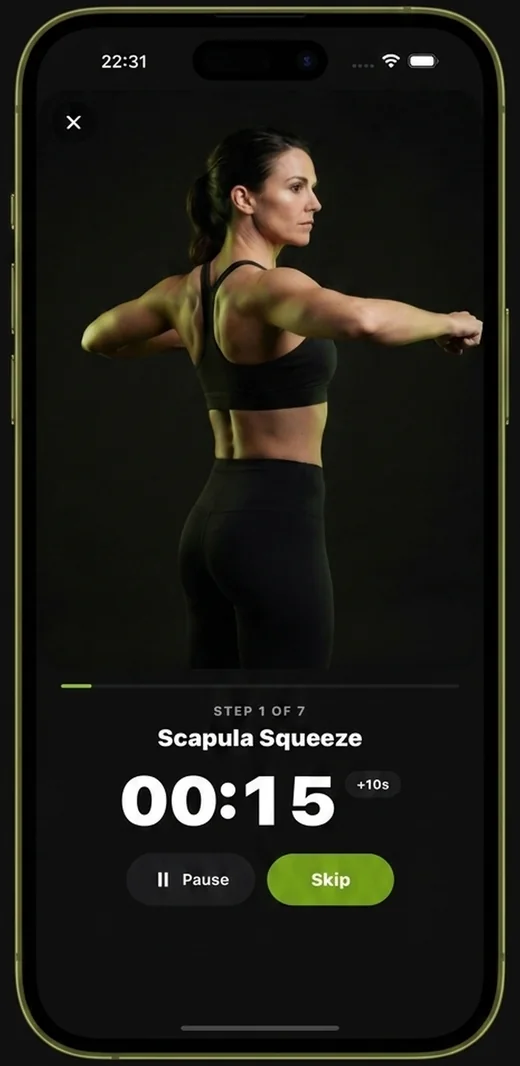
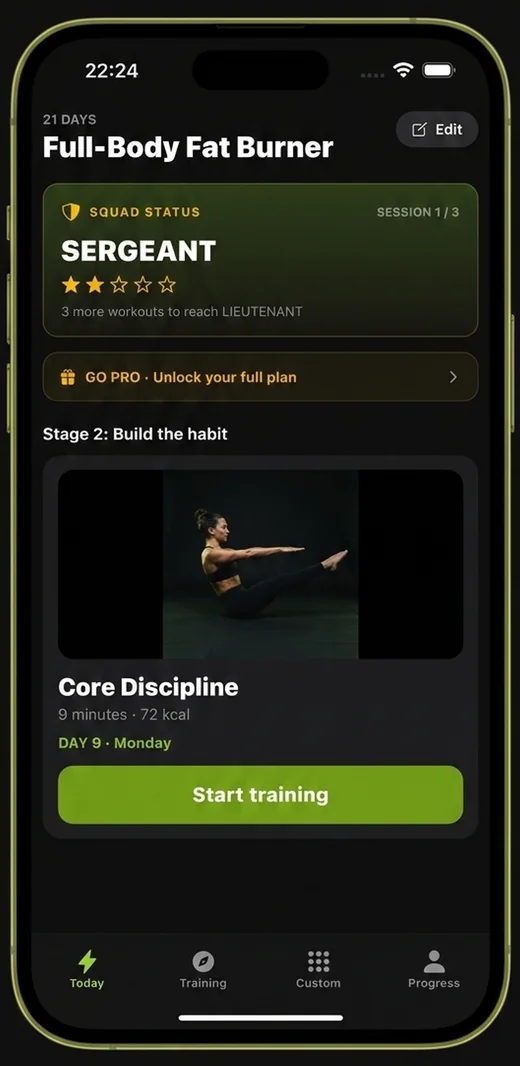

This page gives you the military calisthenics workout itself: a 30-minute daily session you can run anywhere with nothing but a pull-up bar. The philosophy behind it is simple but demanding — master the basics, hold a high standard, and repeat them with ruthless consistency. That is how military fitness tests are passed, and it is what the workout below is built to develop.
New to the method and want the background first — where it comes from, how it differs from regular calisthenics, and the standards it is designed to pass? Read what military calisthenics is, then come back and train.
Dead-hang to strict pull-ups — the single hardest standard on most fitness tests.
Push-ups, dips and the cadence work that builds muscular endurance under fatigue.
Planks, leg raises and loaded carries that hold posture when the ruck gets heavy.
Intervals, runs and circuits that keep the heart rate honest mile after mile.
This is a complete, do-anywhere session. Run it as a circuit or work each block in order. The only equipment you need is a pull-up bar. Scale every number to your level — the standard is honest effort, not someone else's reps.
50 jumping jacks, 20 arm circles each direction, 20 bodyweight squats and 10 leg swings per leg. Raise your heart rate and loosen the shoulders and hips before loading them.
Perform 5 sets of push-ups to two reps short of failure, resting 60 seconds between sets. Keep a straight line from heel to head and lower your chest to within a fist of the floor.
Complete 5 sets of strict pull-ups, resting 90 seconds between sets. If you cannot yet do a pull-up, substitute slow negatives or dead hangs to build the strength.
Alternate 4 sets of 25 air squats with 20 walking lunges (10 per leg). Drive through the heels and keep your chest tall throughout.
Four rounds of a 45-second plank followed by 15 hanging or lying leg raises. Brace the abs and avoid letting the lower back arch.
Finish with a 10-minute run at a hard but steady pace, or 5 rounds of 10 burpees and a 200 m sprint. This is the engine work that mirrors a real fitness test.
Run the session above on the training days below, adding volume each week. Rest days are for walking, mobility and recovery — not nothing. This is just a sample week — for the full beginner-to-advanced program with an 8-week progression and a printable PDF, follow the complete military calisthenics workout plan.
| Week | Training days | Focus | Push-up / pull-up target |
|---|---|---|---|
| 1 | Mon / Wed / Fri | Build the base & nail form | 5×8 / 5×3 |
| 2 | Mon / Tue / Thu / Sat | Add a fourth day | 5×10 / 5×4 |
| 3 | Mon / Tue / Thu / Fri / Sat | Add volume & conditioning | 5×12 / 5×5 |
| 4 | Mon / Tue / Wed / Fri / Sat | Test week — chase the standard | 5×15 / 5×6 |
Targets vary by branch, age and country, but these are realistic benchmarks a military calisthenics workout is built to reach. Train toward the numbers your own test requires.
| Exercise | Recruit | Soldier | Operator |
|---|---|---|---|
| Push-ups (2 min) | 30 | 50 | 75+ |
| Pull-ups (strict) | 5 | 12 | 20+ |
| Sit-ups / leg raises (2 min) | 40 | 60 | 80+ |
| 2-mile / 3 km run | 18:00 | 15:00 | 12:30 |
The current 8-exercise Army Recovery Drill: every stretch in order, step-by-step form, commands, hold times, modified versions and what it really does.
Read brief →The firefighter CPAT: all eight events with weights and distances, the warnings that fail you, the 10:20 time budget and an 8-week prep plan.
Read brief →How to do a hand-release push-up to the Army standard, what makes a rep not count, the official AFT minimum and maximum reps for every age group, and a 6-week plan to add reps.
Read brief →About 30 minutes. It runs as a warm-up, a strength block, a conditioning block and a cool-down, and the only equipment you need is a pull-up bar. Scale every rep count to your own level — the standard is honest effort, not someone else's numbers.
Yes. Progressive bodyweight training builds real muscle, especially in the chest, back, shoulders, arms and core. The key is progressive overload: add reps, add sets, slow the tempo, or move to harder variations such as archer push-ups and weighted pull-ups as you get stronger.
Most people make strong progress training 4 to 5 days per week, leaving at least one full rest day. Beginners should start with 3 sessions per week and add days as recovery allows. Because the workout is low-impact and joint-friendly, it can be run more frequently than heavy weightlifting.
The only essential is a pull-up bar. Everything else — push-ups, squats, lunges, planks, burpees and running — uses just your bodyweight and a patch of ground, which is why this style of training works in a barracks, a garage or a hotel room.
Most trainees notice better endurance and muscle tone within 4 to 6 weeks of consistent training, and meaningful strength gains — such as adding several strict pull-ups — within 8 to 12 weeks. Consistency and progressive overload matter far more than any single workout.
Absolutely. Every movement scales: push-ups can start on an incline, pull-ups can begin as dead hangs and negatives, and rep counts can be halved. Beginners should focus on clean form and gradually build volume before chasing test standards.